Build With Polyguard
Polyguard provides in-line trust checks that you can embed within any real-time web or mobile flow. A trust check is a cryptographically verified identity confirmation. It produces signed, non-repudiable transaction logs of the trust chains involved, giving both parties auditable proof of identity.
This section covers everything a platform engineering team needs to integrate Polyguard trust checks into their product.
You license the platform by committed verification volume and the factors you turn on, so your per-check rate stays predictable. Enable only the factors your use case needs, from device identity and government ID to PG-Presence and geographic region. Common uses include applicant verification on any ATS or custom careers site, onboarding, high-value transactions, account recovery, and financial-services flows.
System Architecture
The diagram below shows the full Polyguard system, from the mobile and web SDKs through the API layer to the audit and records infrastructure.
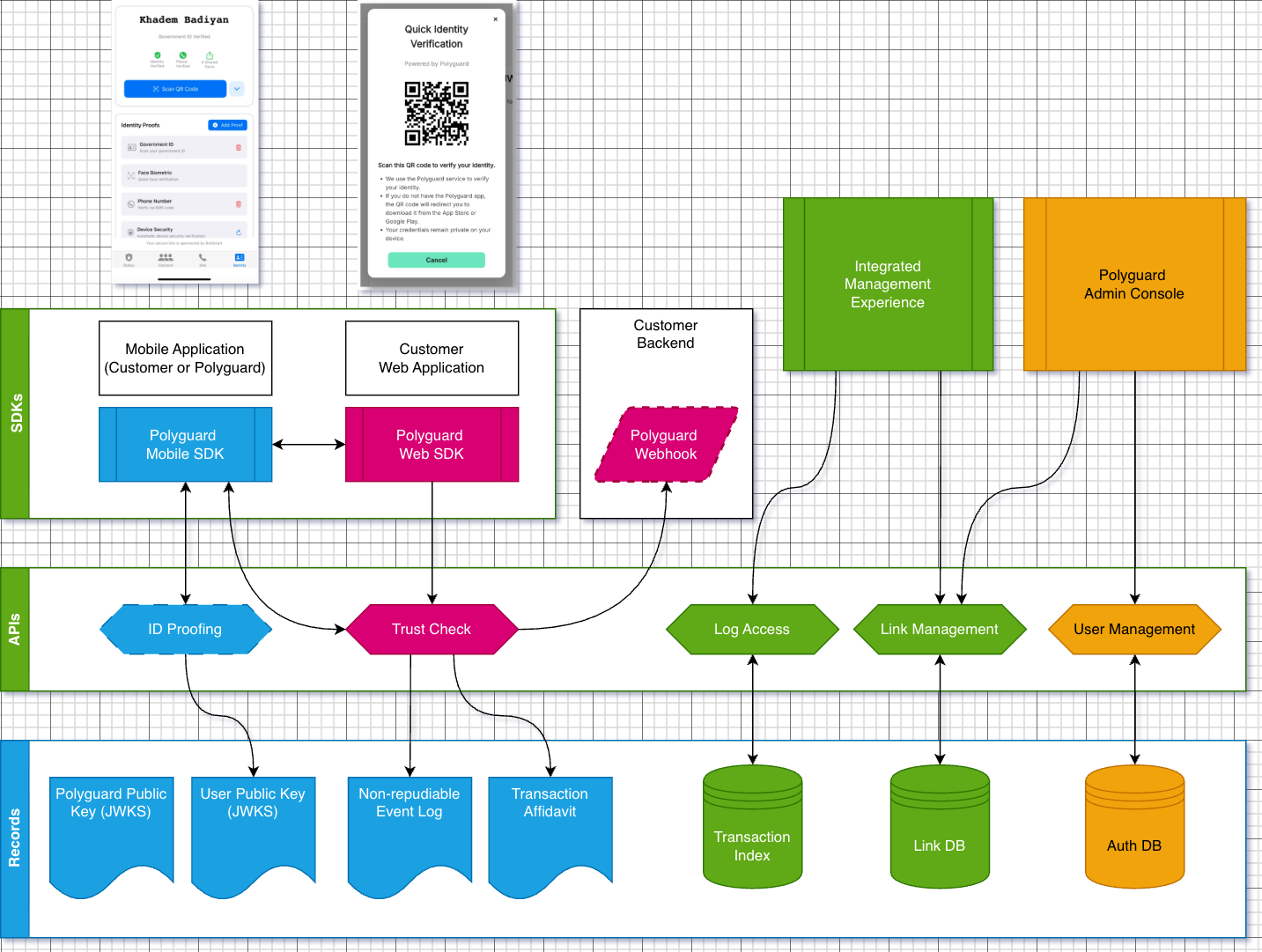
Color-Coded Workflow Zones
| Color | Zone | Description |
|---|---|---|
| Pink | Trust Check | The primary end-user-facing integration. This is the real-time flow where identity verification happens -- modal display on desktop, app redirect on mobile, and websocket coordination between both. |
| Blue | Audit & Records | Read-only APIs and workflows for retrieving event logs, transaction affidavits, and public key infrastructure endpoints. Used for compliance, dispute resolution, and record-keeping. |
| Yellow | Partner Management | Account management for Polyguard partners (Platform Operators). Covers account setup, app configuration, and API credential management. |
| Green | Business Customer | The embedded or integrated management experience for business customers of the Platform Operator. Link creation, session monitoring, and result retrieval. |
What You Can Build
With the Polyguard SDKs and APIs, you can:
- Embed identity verification into any workflow -- onboarding, transactions, access requests, help desk calls, or any moment where you need to confirm someone is who they claim to be.
- Choose which proofs to require -- from device identity and government ID to real-time presence verification and geographic location.
- Receive cryptographic proof of each verification -- every trust check produces a signed JWT bundle and a transaction affidavit suitable for audit and litigation.
- Run entirely self-hosted if your compliance requirements demand it, or use Polyguard's global SaaS infrastructure.
Section Contents
| Page | What It Covers |
|---|---|
| Key Concepts | Terminology, object model, and the proof types available in a trust check |
| Trust Check Lifecycle | The three phases of every trust check: Preparation, Trust Check, and Audit |
| Authentication & Authorization | Hardware attestation, session tokens, and SSO integration |
| Web SDK Quick Start | Minimal code to embed a trust check in a web application |
| Multitenancy & Regionalization | SaaS vs. self-hosted deployment, PKI constraints, and regional sharding |
External Resources
| Resource | URL |
|---|---|
| Web SDK reference | dev.polyguard.ai |
| REST & WebSocket API docs | api-global.polyguard.ai/docs |
| Mobile SDK documentation | Available separately under license agreement |